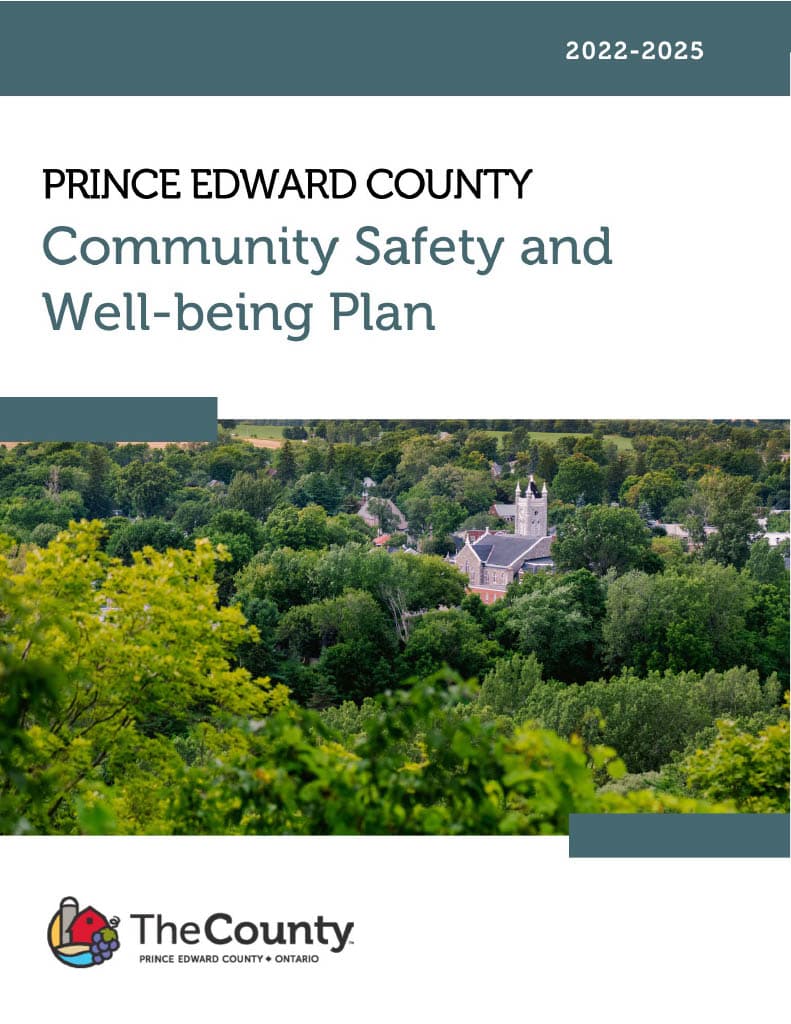
Community Safety & Well Being: What Communities Updating Their Plans Might Want to Look At Now
Since January, I’ve been attending Community Safety and Well-Being (CSWB) Action Team meetings in Prince Edward County. Even in that short time, I’ve been struck by the level of collaboration and commitment (i.e., people showing up consistently, sharing information across sectors, and doing the quieter operational work that doesn’t often make it into formal plans).
As a policy wonk at heart, seeing that work in action prompted me to step back and look more closely at where CSWB came from, and what communities elsewhere have learned as these models mature.
Where CSWB Came From
Ontario didn’t invent CSWB Plans from scratch. Ontario drew heavily from the UK’s Community Safety Partnership model. Where police, municipalities, health, housing, probation, and community plan together and from Australian place-based prevention approaches.
As a policy wonk at heart, seeing that work in action prompted me to step back and look more closely at where CSWB came from, and what communities elsewhere have learned as these models mature.
Though not explicitly stated, the political logic underlying CWSBs is clear:
- Respond to critiques of over-policing;
- Provide a non-abolitionist reform pathway;
- Shift pressure off police budgets without saying so explicitly; and
- Align with federal/provincial priorities on mental health, housing, and gender-based violence.
Seen this way, CSWB plans are a sound, evidence-based policy solution. Ontario’s real innovation, however, was embedding it in legislation and making collaboration a requirement rather than a pilot.
What Communities Are Learning Now
To understand how this plays out in practice, I did a small comparative scan across several Ontario communities at different stages of CSWB implementation, alongside evaluations from the UK and Australia. While contexts vary, a few consistent lessons stand out.
1. CSWB works best as a coordination mechanism
Communities make the most progress when CSWB is clearly positioned as a way to align and support existing work, rather than as a standalone strategy or a source of new programs.
You can see this working when Action Team agendas focus on:
- removing barriers between services,
- clarifying roles and responsibilities, and
- addressing gaps that sit between mandates.
Across jurisdictions, plans with dedicated coordination capacity, whether formally titled or informally recognized, show greater continuity and resilience. Where coordination is added “off the side of someone’s desk,” progress becomes harder to sustain. Plans tend to stall not because partners disengage, but because no one owns the connective work.
2. Collaboration holds when the operational rules are clear
Many communities report strong early momentum driven by relationships and goodwill. Over time, however, operational complexity increases.
Where collaboration holds, there is clarity about:
- who has decision-making authority;
- what issues can be resolved at the Action Team level; and
- when and how matters are escalated.
Where these structures are missing, Action Tables risk becoming discussion forums rather than engines for action. The difference shows up when partners can answer, “Who is responsible for the next step, and by when?” without revisiting the same issue the following month.
3. Measurement and design need to match local reality
Evaluations from the UK and Australia consistently show that fewer, well-chosen indicators outperform broad measurement frameworks. Communities that focus on tracking coordination quality (i.e., referral pathways, response times, and access to services) alongside selected outcomes are better able to learn and adapt.
This matters even more for smaller and rural communities, where service density and capacity differ significantly from large urban centres. The strongest CSWB plans borrow ideas from elsewhere but adapt them deliberately, favouring:
- narrower priorities,
- simpler structures, and
- incremental progress over comprehensive coverage.
Plans feel real when they reflect how work actually happens locally, not how it happens on paper somewhere else.
Looking Ahead
CSWB remains a strong and necessary framework. What communities are learning now is not that the model is flawed but that implementation is where success is determined.
As CSWB plans are updated across Ontario, the opportunity is to build on lived experience, operational learning, and lessons from elsewhere, strengthening coordination, clarity, and accountability where it matters most.