The Role of Strategy in Constrained Systems
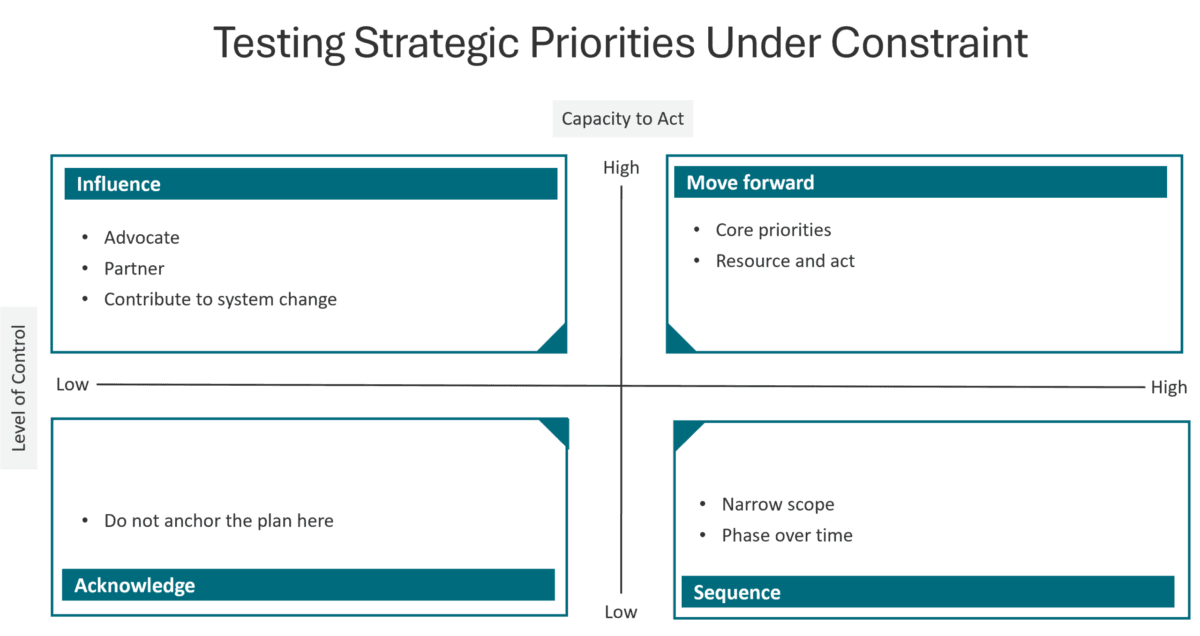
Strategic planning often brings clarity to priorities, even in the face of structural constraints. A useful way to test that clarity is a four-quadrant matrix titled Testing Strategic Priorities Under Constraint. The vertical axis is level of control (low to high); the horizontal axis is capacity to act (low to high). Where control and capacity are both high, the frame is Move forward—set core priorities, resource them, and act. High control with low capacity points to Influence—advocate, partner, and contribute to system change. Low control with high capacity calls for Sequence—narrow scope and phase work over time. Where both control and capacity are low, Acknowledge the limits and do not anchor the plan there.
The harder question is what do with that clarity.
Organizations are often clear on what matters. Fewer are able to make the choices required to support it.
Strategy does not remove constraints. It defines how an organization will operate within them.
This includes making decisions about:
-
where to focus effort
-
what outcomes to prioritize
-
how to align leadership around what is feasible
When done well, strategy creates a shared understanding of direction. It supports decision-making and provides a foundation for external conversations about what sits beyond the organization’s control.
It also creates a clearer foundation for external conversations. When constraints are structural, strategy helps organizations articulate what is needed beyond their control.
Where strategy often falls short is in what comes next.
Clarity on direction does not automatically translate into changes in how work is organized, resourced, or delivered. This is where many organizations get stuck.
Not because the strategy is unclear, but because its implications for day-to-day work have not been fully worked through.
Testing strategic priorities under constraint
One way to make this concrete is to map priorities against two questions:
-
What level of control do we have?
-
What capacity do we have to act?
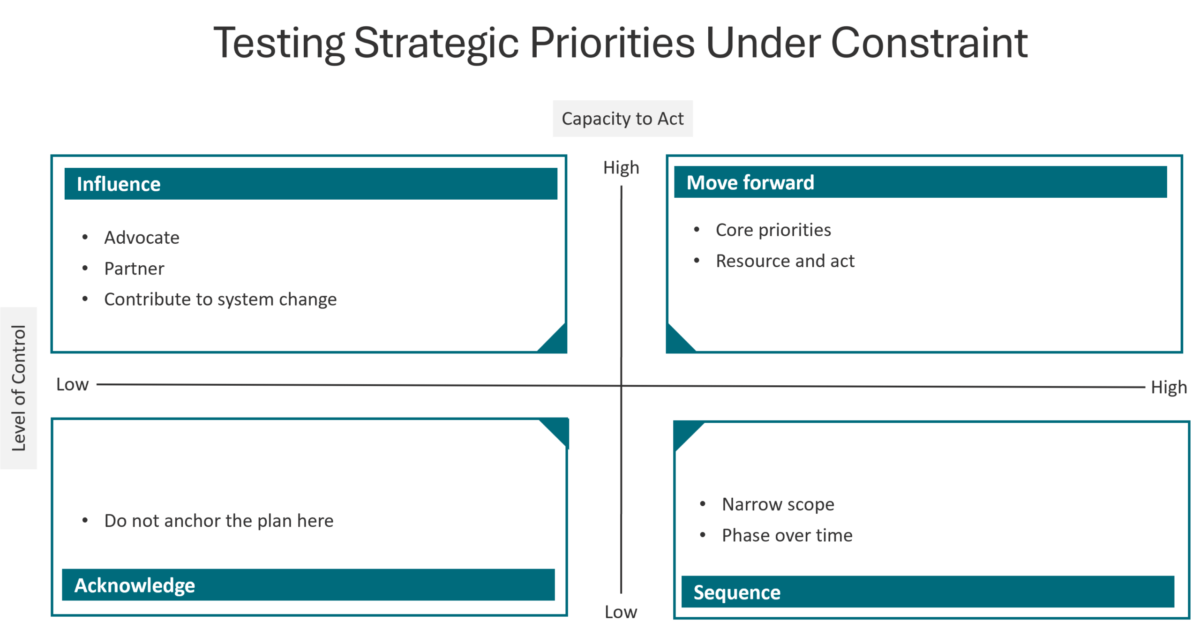
| Level of control | Capacity to act | Quadrant | Implied action |
|---|---|---|---|
| High | Low | Influence | Advocate; partner; contribute to system change |
| High | High | Move forward | Core priorities; resource and act |
| Low | Low | Acknowledge | Do not anchor the plan here |
| Low | High | Sequence | Narrow scope; phase over time |
This exercise helps distinguish between:
-
where the organization can act
-
where it needs to adapt
-
and where it is responding to conditions outside its control
It also makes visible a core part of strategic planning that is often left implicit: not everything can move forward at once.
Strategic planning defines direction.
Its value is realized when that direction is matched with decisions about what moves forward, what waits, and what changes.