Translating Strategy Into Action
Over the past few weeks, I’ve been writing about strategic planning under constraint:
- Structural pressures that sit outside organizational control
- The role of strategy to address structural constraints
- How to set the organizations up for success by addressing the missing middle
The final step is what makes strategy usable in this context.
From strategy to implementation
Operational planning and ongoing monitoring.
A simple way to think about it is a four-stage process. Context captures structural pressures, funding constraints, and capacity limits. Strategy sets clear priorities, informed trade-offs, and resource allocation. Operational planning assigns owned actions with timelines and sequencing aligned to capacity. Monitoring tracks progress, surfaces risks, enables informed decisions, and supports adjustment. A feedback loop—learn, adapt, re-align—connects monitoring back to strategy and operations. Boards gain visibility into progress, risks, and decisions; staff gain clarity on priorities, progress, and how strategy is building a stronger organization.
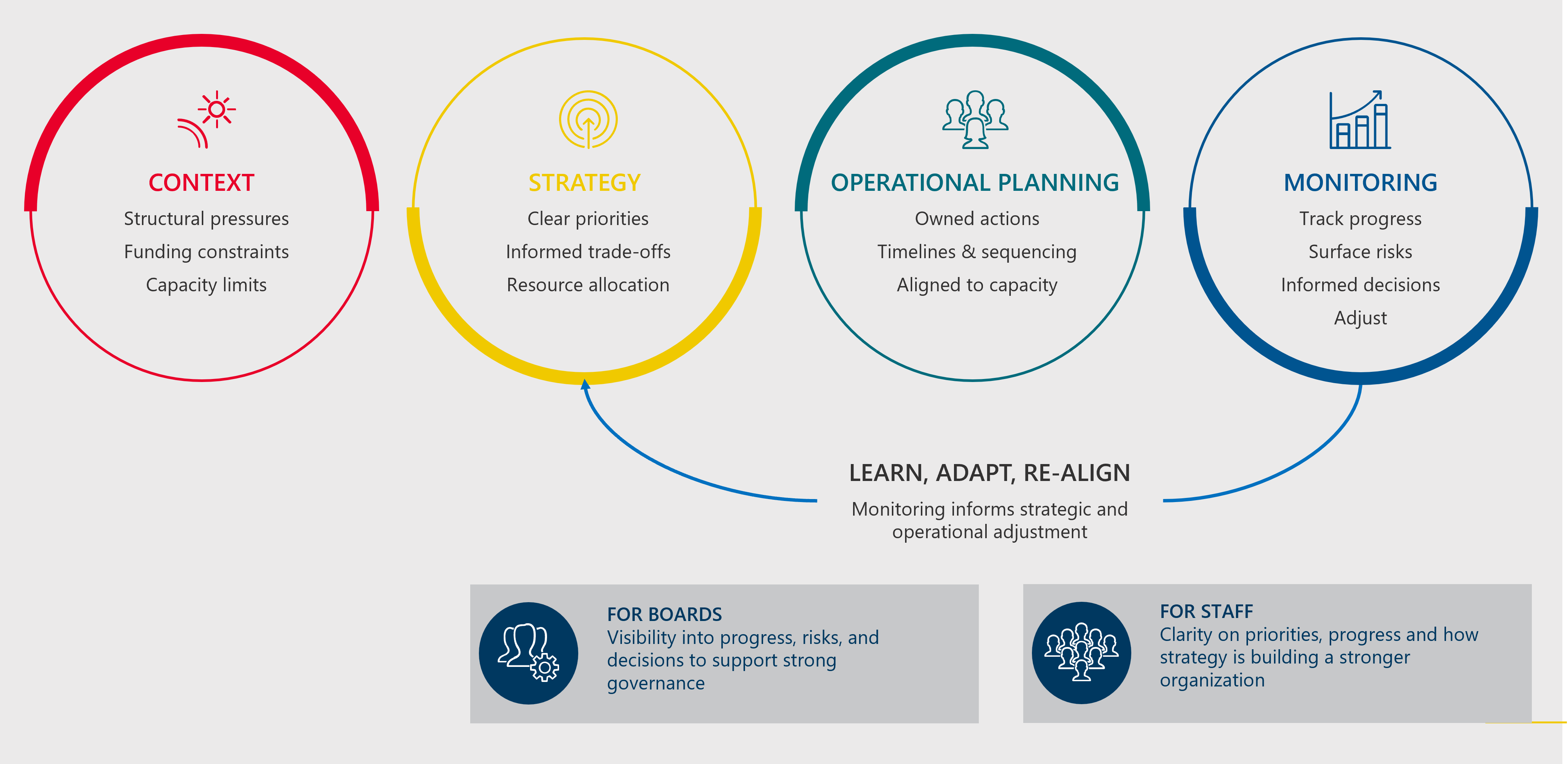
| Stage or element | Description |
|---|---|
| Context | Structural pressures; funding constraints; capacity limits |
| Strategy | Clear priorities; informed trade-offs; resource allocation |
| Operational planning | Owned actions; timelines & sequencing; aligned to capacity |
| Monitoring | Track progress; surface risks; informed decisions; adjust |
| Feedback loop | Learn; adapt; re-align — monitoring informs strategic and operational adjustment |
| For boards | Visibility into progress, risks, and decisions to support strong governance |
| For staff | Clarity on priorities, progress, and how strategy is building a stronger organization |
This is what turns a plan into something an organization can deliver.
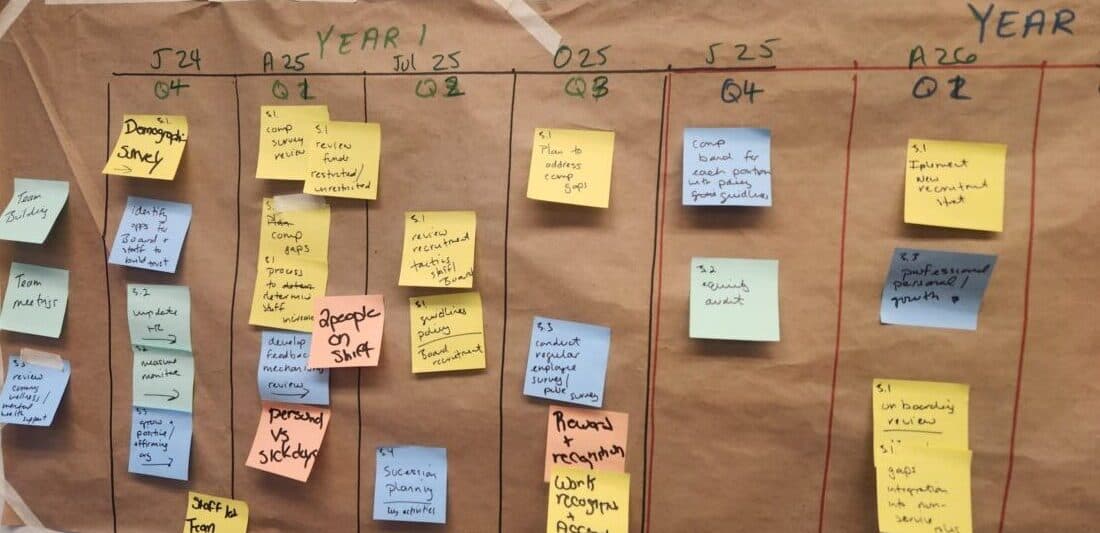
In practice, building the operational plan means working directly with the management team to define:
- who owns each priority
- what moves now versus what is sequenced
- what is realistic given current capacity
- where coordination across teams is required
This is where strategy becomes grounded. Teams leave with a plan they can implement, not a list of additional expectations.
The second part is monitoring.
In constrained environments, monitoring is not just oversight. It is how organizations stay responsive.
For Boards, it supports governance and decision-making. They need visibility into progress, risks, and where trade-offs are required.
For staff, it needs to be equally practical. It should show whether the work is manageable, where pressure is building, and what is shifting.
Building an operational plan teams can actually use
A simple structure is enough:
Priority
Owner
Status
Progress
Measures
Risks / decisions
Used consistently, this connects strategy to real work and creates alignment between teams and Boards.
Under constraint, strategy only works if it can be implemented within the system that exists.
Operational planning and monitoring are what make that possible.
Strategy becomes real through operations
Under constraint, strategy succeeds when organizations can translate priorities into coordinated, manageable work and adjust as conditions change.