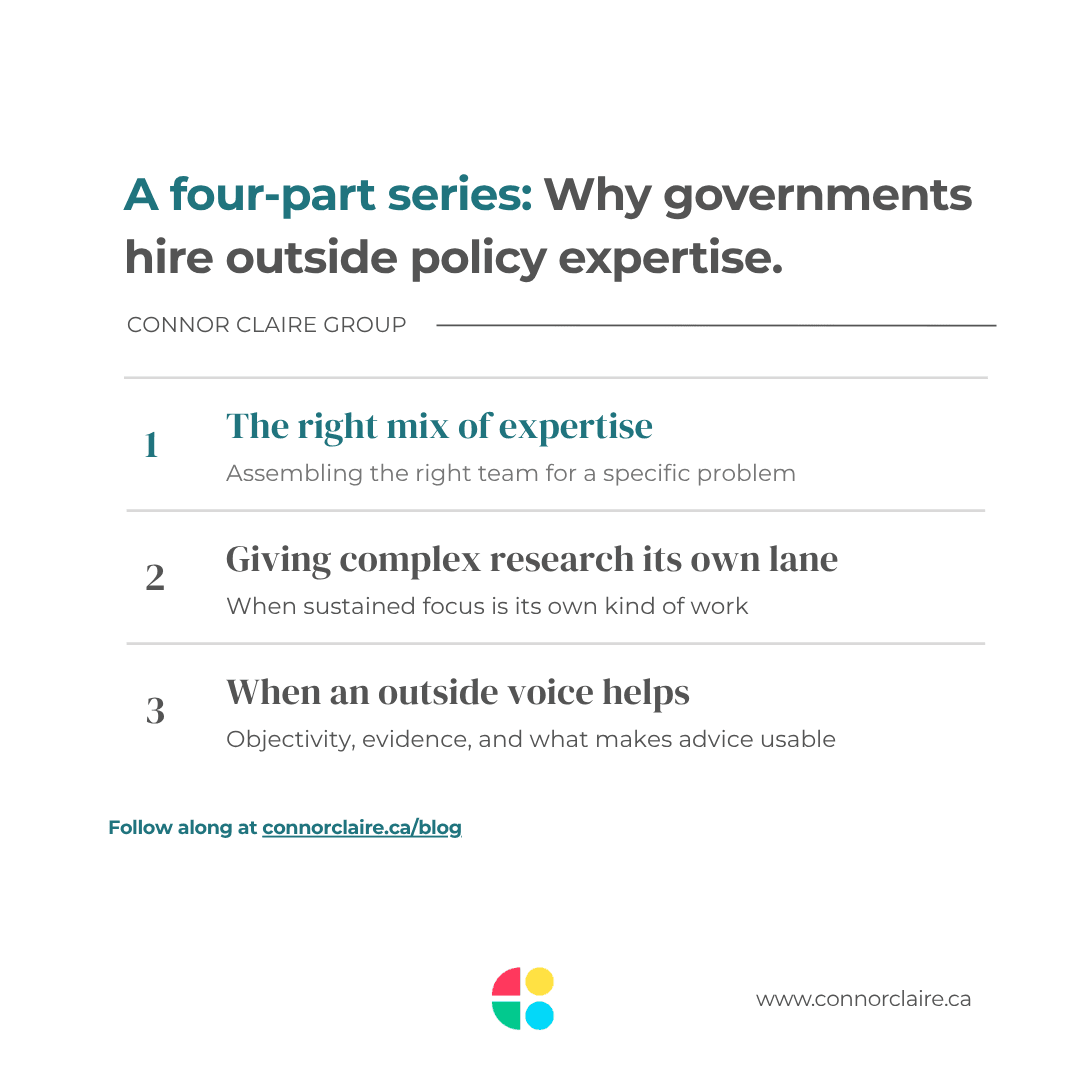
The Right Mix of Expertise
Part Two of a four-part series: Why Governments Hire Outside Policy Expertise
Government policy teams are knowledgeable, committed, and often deeply expert in their files. So when does it make sense to bring in outside help?
One of the most common reasons has nothing to do with expertise. It is about assembly.
Pulling together the right combination of skills for a specific, time-limited problem is structurally difficult inside government. Secondments take time. They require approvals. They pull people away from their own files. A consulting team can bring the right mix of expertise together quickly, without those constraints.
Here is what that looks like in practice.
Bringing the right team to a complex regional challenge
A few years back I led a seniors care and housing strategy for the Northern Region of the North West Local Health Integration Network working in partnership with LBCG and Keesic Strategies. The client was Sioux Lookout Meno Ya Win Health Centre, with funding and direction from the Ministry of Health and Long-Term Care.
The Northern Region covers approximately 290,000 square kilometres. It includes Sioux Lookout, Pickle Lake, and 28 First Nations communities to the north, most of them fly-in. Over three-quarters of the population identify as Indigenous.
The work required a very specific combination:
-
deep knowledge of the provincial health and long-term care system,
-
experience working respectfully in First Nations communities,
-
familiarity with the federal-provincial jurisdictional tensions around health services, and
-
an understanding of rural and remote health delivery.
No single ministry team could have assembled that combination quickly. Together, our team brought it to the table from day one.
The work involved eight community visits, stakeholder consultations across a vast geography, and workshops with a steering committee that included provincial and federal government representatives. The result was a strategy grounded in community voices, with costed recommendations across housing, home care, health services and community supports.
The key takeaway: When a problem requires a specific combination of subject matter expertise, lived and professional experience, and jurisdictional knowledge, a well-chosen external team can get there faster and more effectively than an internal secondment process.
What good looks like
The northern Ontario project is one that I am most proud of, and not just because of the depth of the work. It is because the right team changed what the question was.
The Ministry came in wanting to understand the broader needs of the region before making a decision about long-term care beds. The community had been advocating for those beds for years. What the project revealed, through genuine engagement with First Nations communities with Keesic Strategies leading the engagement, was that the picture was much fuller than either side had initially framed it.
First Nations Elders wanted to stay in their communities. The province had historically taken the position that on-reserve services were a federal responsibility. But that stance meant that provincially funded services like seniors activity centres in Sioux Lookout were being used almost exclusively by non-Indigenous residents. That was not the intention, and it was not good enough.
Getting into communities, building trust, and listening carefully produced a strategy that made the case for long-term care beds and for better housing, home care and community supports on-reserve. The Ministry ended up with a much fuller picture of the region than they started with, and a strategy that reflected the needs of everyone in it.
That is what the right team makes possible.
Next in the series: When complex policy research needs its own lane.
Susan Underhill is the founder of Connor Claire Group. She has worked in and with government at the municipal, provincial, federal and First Nations level for over two decades. connorclaire.ca