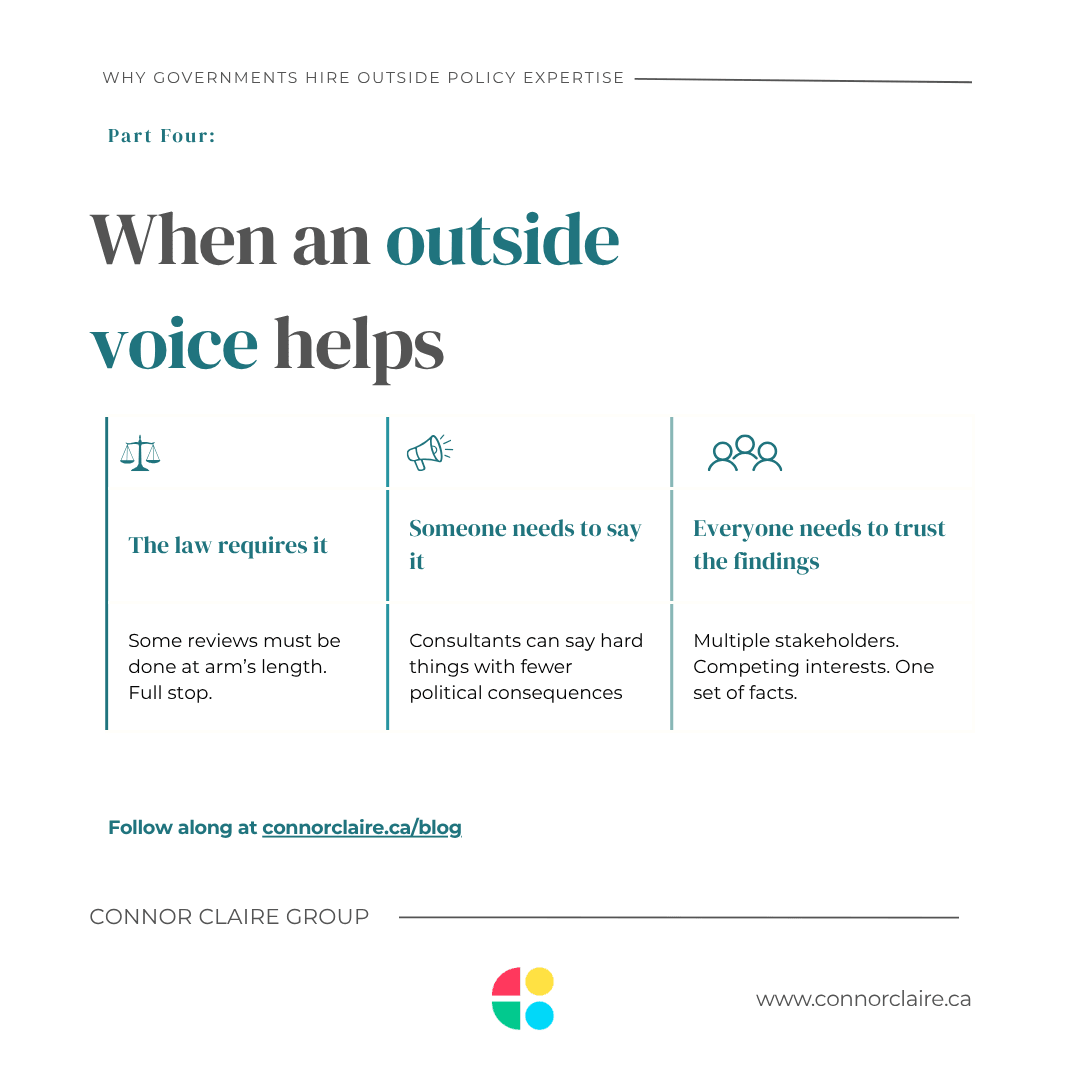
When the work needs to be independent
Part Four of a four part series: Why governments hire outside policy expertise
Sometimes you hire outside expertise not for what they know, or how fast they can build a team. You hire them because the work needs to come from someone with no stake in the outcome.
When the law builds independence in
Sometimes, governments recognize the importance of independent review and build it into legislation. For example, governments create agencies, boards, commissions, and tribunals to solve problems. Over time, circumstances change. The problems that created these bodies may be solved, or may have shifted. And so most governments build in mechanisms to check whether these bodies are still needed, still relevant, and still behaving as intended.
In Ontario, the Agencies and Appointments Directive requires periodic mandate reviews for all provincial agencies, boards, and commissions. For adjudicative tribunals (i.e., bodies that make binding decisions affecting people's rights) the Adjudicative Tribunals Accountability, Governance and Appointments Act, 2009 adds further requirements.
The logic is simple: an agency reviewing its own mandate cannot do so credibly. The incentive to justify continued existence is too strong. And the question of whether a tribunal is operating independently from the government that created it, and not overreaching in the other direction, is one that only an outside reviewer can answer without conflict.
Governments of different stripes can pull these bodies in different directions. So, part of what a mandate review assesses is whether the governance is holding appropriate oversight, appropriate independence, with neither side overreaching.
When bureaucrats can't say what they know
Sometimes government staff recognize the political pressure to move in a particular direction, and the people closest to the file are not always best positioned to push back. They may not be heard. They may face consequences for trying.
An outside advisor can surface policy evidence and carry some of the political weight of delivering them.
When stakeholders need to trust the messenger
Independence also matters when multiple parties with competing interests need to act on the same findings. When the Regional Municipality of York commissioned research on its centralized wait list for housing supports, there were clients, housing providers, regional staff, and community organizations all at the table. York needed findings that all of them could trust and act on together.
An outside team could synthesize what they heard, what other jurisdictions had done, and what the legislation allowed and facilitate a process where parties could bring forward options from a common understanding. An internal team researching a system the region itself runs could not have done that credibly.
What good looks like
Good independence work starts with being clear about what independence actually requires. It means genuine arm's-length from the findings: no steering of conclusions, no softening of results to protect a relationship. It means a process rigorous enough that any party could examine it and find it sound. And it means delivering findings that reflect what the evidence shows, even when that is uncomfortable for the client.
Government clients who commission this kind of work usually already understand all of that. They are not hiring an outside advisor because they distrust their own teams. They are hiring one because they know that some questions can only be answered credibly from the outside.
This is the final post in a four-part series on why governments hire outside policy expertise. Parts 1 through 3 are available at connorclaire.ca. Next series: The craft of policy consulting.
Susan Underhill is the founder of Connor Claire Group. She has worked in and with government at the municipal, provincial, federal and First Nations level for over two decades, including leading ten mandate reviews for Ontario agencies and tribunals.
The mandate reviews and Regional Municipality of York centralized wait list project were completed in partnership with LBCG - Consulting for Impact.