Strategic Plan, Service Model, or Organizational Design? How to Tell Which One You Need
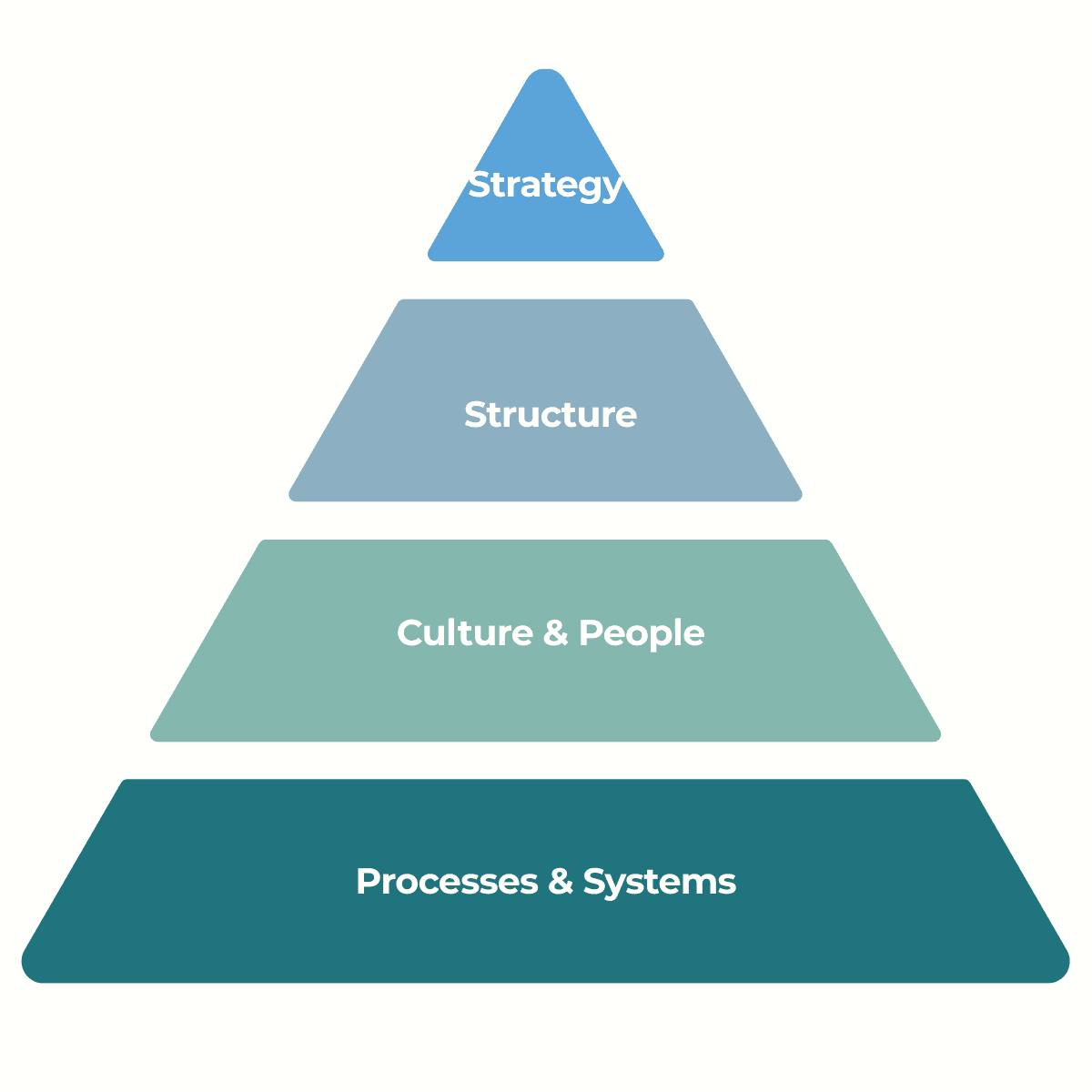
Every organization is really just a few things stacked on top of each other: what it's trying to achieve, how it's structured to do that, the people and culture doing the work, and the processes and systems the work runs on. Change one and the others feel it. That's worth keeping in mind whether you're setting a five-year direction, redesigning how a service reaches people, or fixing a chart. Not just when you're deep in org design work.
The layers
- Strategy is the direction: what the organization is trying to achieve, and for whom.
- Structure is who's accountable for what, and who reports to whom.
- Culture and people are how work actually gets done day to day, and whether the people doing it have what they need.
- Process and systems are the mechanics: the steps, the data, and the technology carrying the work from one layer to the next.
None of these sit in isolation. When I worked with the University of Alberta on a large administrative redesign, the reporting lines were redrawn in weeks. Shifting the culture underneath them, from how things had always been done toward something more efficient and service-minded, took far longer. The chart moved fast. The layer underneath it didn't.
Three different questions
Clients often come to me asking for one of three things: a strategic plan, a new service delivery model, or an organizational design. They're not the same, and each one usually starts by focusing on a different layer.
- A strategic plan starts with strategy: what should we be doing, for whom, and why, over the next three to five years.
- A service delivery model starts with process: how should someone actually receive our service, and is that the best way to reach them.
- Org design starts with structure and the people inside it: do we have the right roles, in the right configuration, with the right authority, to actually deliver.
How to tell which one you need
You probably need strategic planning if: Leadership genuinely disagrees about where the organization is headed. A funder or board is asking for a multi-year plan. You haven't revisited your mission or priorities in years and it shows.
You probably need a new service delivery model if: A funder, regulator, or government partner has changed the rules for how a service must be delivered. You keep hearing the same complaints about access or experience from the people you serve. You're running more programs or channels than you can actually deliver well.
You probably need org design if: The same few people keep becoming bottlenecks. New staff have no one senior to learn from. Nobody is quite sure who's accountable for a given decision. You're delivering more, or differently, than your current structure was ever built to support.
In practice these connect, because the layers underneath them do. When the province introduced a new delivery model for autism services, Surrey Place needed it. That was a change to the process layer, not a structural problem on its own. But it meant Surrey Place then had to redesign parts of its internal structure to actually operate under the new model. Skipping straight to org design without understanding the service model behind it would have meant redesigning the wrong layer.
Why the diagnosis matters more than the fix
Every one of these tools works, but only when it's aimed at the layer that's actually broken. Get it wrong and you end up with a polished strategic plan that doesn't change what people experience, or a clean new org chart sitting on top of the same unresolved disagreement about direction.
Getting the diagnosis right means the change actually holds. Staff stop absorbing a new reorg every eighteen months for a problem that was never structural to begin with. Boards and funders see resources go toward the thing that was actually broken. Leadership gets to spend its authority and its people's goodwill on a change that sticks, instead of spending it again next year on the same problem wearing a different name.
That's the real payoff of knowing which layer you're actually working on before you start building the answer.
Susan Underhill is the founder of Connor Claire Group, a policy and management consulting practice serving government and not-for-profit clients.