Span of Control: How Many People Should One Manager Lead?
Organizational Design Toolkit: Part 4
When organizations ask me to benchmark their structure, there's usually a couple of questions underneath the request: how many people should each manager lead? And how do we compare to our peers?
It's the question I hear most often. It's also one where a simple comparison can mislead, unless you understand what sits behind the numbers.
In Part 3, I described a review of a large provincial inspection program. One number stood out right away: each performance manager was responsible for roughly 40 inspectors.
Many of those inspectors were new. They needed coaching, feedback and someone to go out in the field with them while they learned the job. With 40 people each, managers simply couldn't do it. They were working well beyond normal hours, and still falling behind.
The cost showed up in the work. Experienced inspectors were completing up to 15 major inspections a year, while many of the newer inspectors had completed only two. Turnover made it worse, because every departure meant starting over with someone new.
The other inspection programs we looked at had between 8 and 25 staff per manager. We recommended adding front-line supervisors to bring the ratio down to about 15, so managers would finally have time to develop their people.
There's no magic number
That doesn't mean 15 is the right answer everywhere, or even the right answer for this department over the long-term. In another review, benchmarking found spans ranging from 90 to 100 staff in some clinical areas, to 20 to 30 in specialized programs, to just 4 to 6 in administrative teams. All of them made sense for the work being done. Clinical settings and organizations where the work is repetitive generally can handle much larger team-to-manager ratios.
New research from Gallup, which studies workplaces around the world, adds some helpful nuance:
- Most managers lead small teams. The average team has grown to about 12 people, but that's because a few very large teams pull the number up. Most managers actually lead 5 or 6 people. So comparing yourself to a peer "average" may not tell you much.
- A good manager matters more than the number. Strong managers can lead larger teams well. Managers without the right skills or support struggle, even with small teams.
- Regular feedback makes the biggest difference. People who get useful feedback from their manager every week are far more likely to feel invested in their work: about 7 in 10, compared with 1 in 4 of those who don't. That holds true whatever the size of the team.
- Managers need time to manage. When managers spend a large share of their week doing front-line work themselves, they become less invested in their own jobs, and it gets harder as their teams grow.
What tips the balance
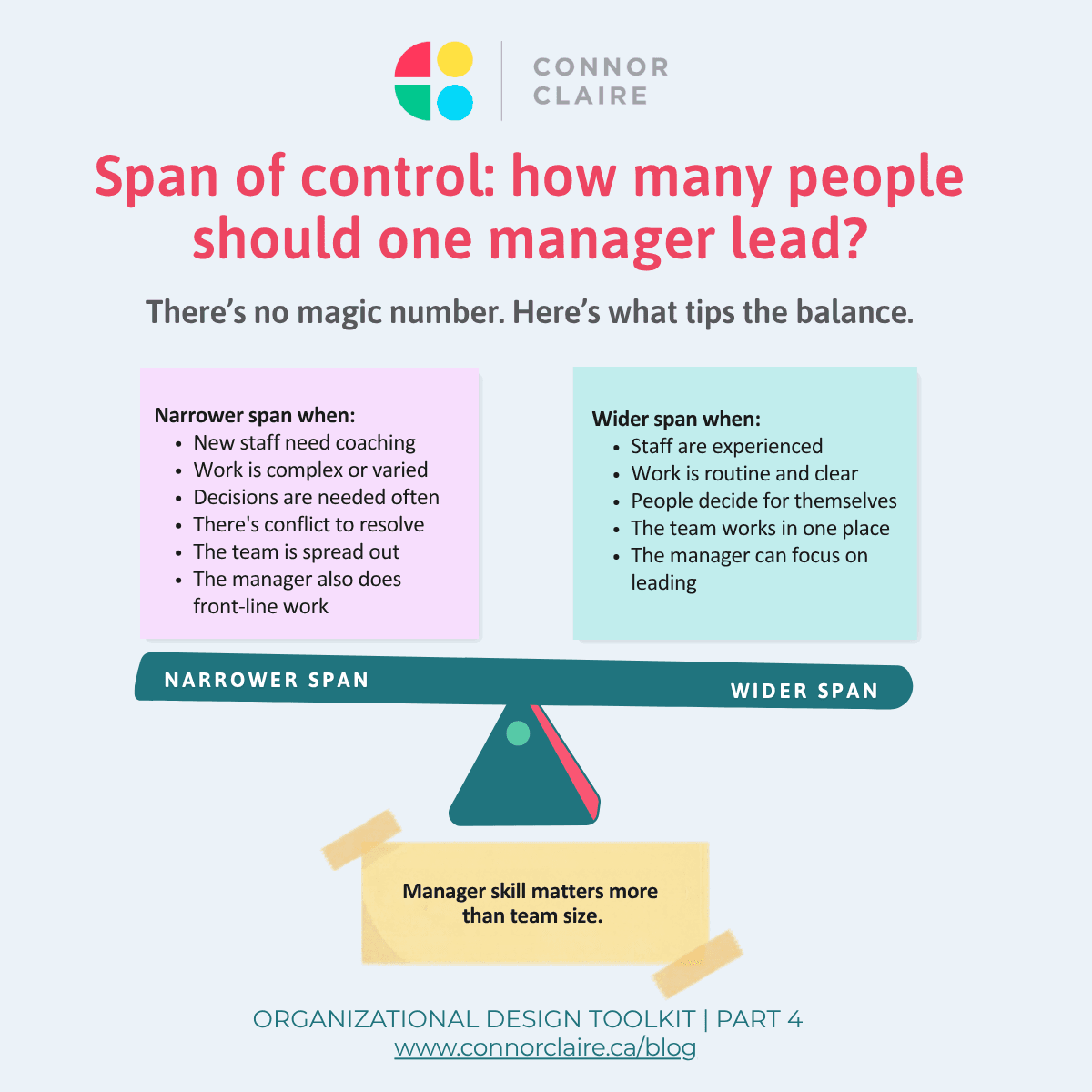
A span of control usually needs to be narrower when:
- Staff are new or need a lot of coaching
- The work is complex or different every time
- Decisions or approvals are needed often
- There's a lot of conflict to help resolve
- The team is spread across locations
- The manager also carries their own front-line work
That last one matters a lot in nonprofits, where many managers also carry a caseload or cover shifts.
A span can be wider when staff are experienced and independent, the work is routine with clear procedures, and the manager can focus fully on leading.
Start with the work
Benchmarking can tell you how your spans compare. It can't tell you whether they're right for your work. When I look at spans of control in a review, I start with the work and the people doing it, not a target number. The right span is the one that lets managers actually support, coach and develop their teams.
Next in this series: who does what at each level in a small nonprofit.