Shared Services: When to Centralize and When to Keep it Local
Organizational Design Toolkit: Part 6
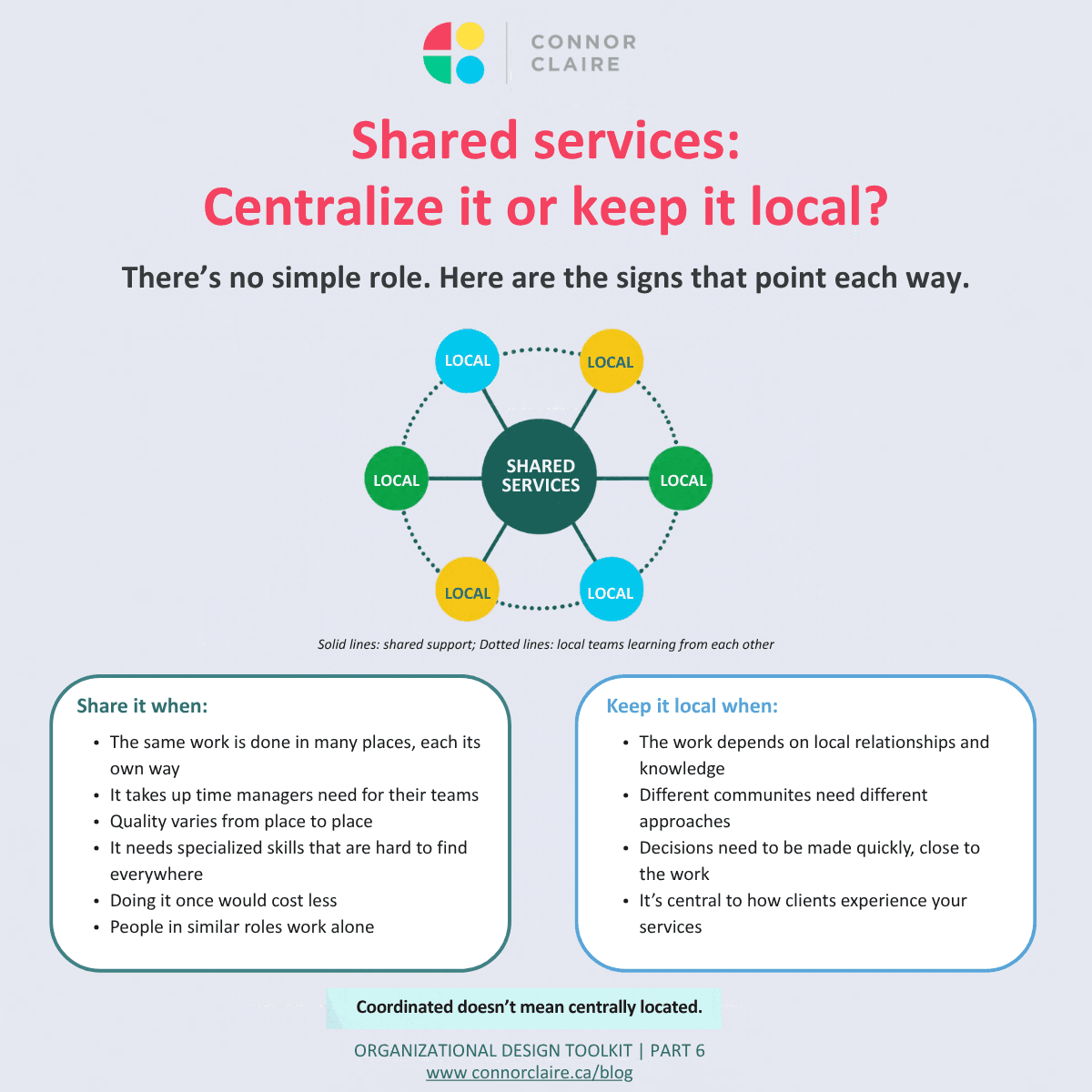
A few years ago, I helped a national organization design a new operating model for its community programs. Each program had grown up locally and found its own way of doing the same tasks. Some things, like policy expertise, clearly benefited from a central team. But centralizing wasn't the only way to share expertise. Grouping similar programs let them learn from each other while staying rooted in their communities. Coordinated doesn't mean centrally located.
There's no simple rule
People often turn to a consultant hoping for a clear rule about what to centralize. There isn't one, but there are patterns.
Most often, my projects have brought together "back office" functions like HR, finance and IT. These need specialized expertise that's hard to find, and hard to afford, in every location. Centralizing them is often one of the most effective ways to save money, while giving every program stronger support.
Sometimes it's support for the front line. In the inspection program from Parts 3 and 4, each region was training its own new inspectors. A central training function freed managers to coach and gave every new inspector the same strong start.
Signs a function should be shared
- The same work is being done in many places, each in its own way
- It takes up time front-line managers need for their teams
- Quality or consistency varies from one place to the next
- It needs specialized skills, like HR, finance or IT, that are hard to find in every location
- Doing it once, well, would cost less than doing it many times
- People in similar roles are working alone and could learn from each other
Signs it should stay local
- It depends on local relationships and knowledge of the community
- Different communities need different approaches
- Decisions need to be made quickly, close to the work
- It's central to how clients experience your services
Start with the work
Most organizations end up with a mix. Finding the right one starts with listening to the people doing the work: what slows them down, where they feel alone, and what they'd lose if decisions moved further away. Their answers, tested against the design principles from Part 2, shape recommendations that fit.
Next in this series: change management, and why the new structure is the easy part.