When Gender-Based Violence Meets Elder Abuse: The Overlooked Intersection Policy Can’t Afford to Ignore
Across Canada, elder abuse and gender‑based violence (GBV) are too often treated as separate issues. Yet older adults, particularly women and gender‑diverse seniors, frequently experience abuse that straddles both domains. It’s time for integrated policies, funding, and partnerships.
The Canadian Profile
Canada’s seniors—particularly older women—face unique and overlapping risks of gender-based violence (GBV) and elder abuse. Understanding the scale and dynamics of this intersection is vital for designing effective, inclusive policy and funding approaches.
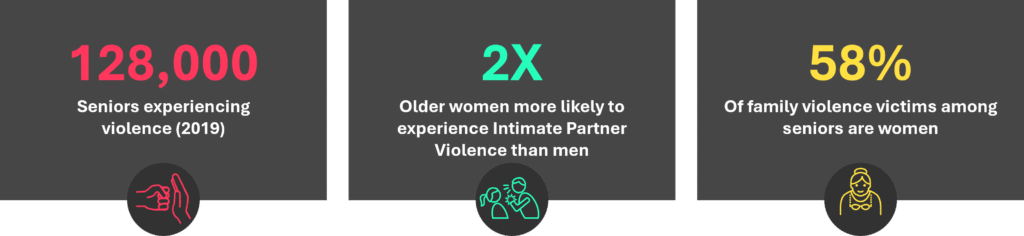
| Stat | Description |
|---|---|
| 128,000 | Seniors experiencing violence (2019) |
| 2X | Older women more likely to experience intimate partner violence than men |
| 58% | Of family violence victims among seniors are women |
SOURCES: Statistics Canada’s 2019 General Social Survey (GSS) on Canadians’ Safety and related PHAC reporting on older adults and violence
These figures underscore that while elder abuse and GBV may manifest differently in later life, both remain critical concerns, often underreported and poorly addressed by siloed systems.
Why the Overlap Matters
Older adults, especially women, face unique and compounded risks for abuse. Research shows that:
- Perpetrators are often known to the victim – partners, adult children, caregivers – mirroring GBV patterns.
- Economic dependence and unequal access to financial resources can make it harder to leave abusive situations, particularly for women who have been out of the workforce for decades.
- Health and disability-related vulnerabilities can be exploited to control or harm an older person.
- Ageism and sexism intersect, leading to systemic under-recognition of abuse and fewer targeted interventions.
When older women, trans, and non-binary people experience violence, they often fall through service gaps. GBV programs may lack accessibility measures or gerontological expertise, while elder abuse programs may not have the trauma-informed, gender-responsive approaches needed to support survivors.
Funding streams are rarely designed to address both GBV and elder abuse together. This leaves organizations scrambling to patch together resources from multiple funders, and survivors navigating disconnected systems.
Local Ontario Insights & Initiatives
There are several examples of where integrated policies and partnerships exist:
- Seniors Safety Line (SSL): In Ontario, the only 24‑hour crisis/support line for older adults facing abuse or neglect, SSL offers emotional support, safety planning, and referrals in over 200 languages.
- Elder Abuse Prevention Ontario (EAPO): The provincial leader in elder abuse prevention provides layered supports—from public awareness and webinars like “Safety Planning: Supporting Older Women Experiencing Violence,” to multilingual tools and resources.
- STOP‑GBV 55+ Project (CNPEA): A national initiative focusing on older women and gender‑diverse people experiencing GBV, this project brings together GBV and elder abuse organizations—including EAPO—to develop trauma‑informed, intersectional tools and practices.
Aligning Ontario’s Action Plan to End GBV with Elder Abuse Strategies
Ontario’s GBV Action Plan and broader investments, from provincial and federal lenses, offer strong levers for embedding elder-inclusive strategies:
Key Pillars of the Ontario GBV Action Plan
- In 2025, Ontario committed $98 million across 83 community projects focused on preventing GBV and supporting survivors—including initiatives like YWCA’s From Financial Violence to Financial Empowerment, promoting economic resilience for survivors.
- The province channels this funding through programs like the Preventing Gender-Based Violence (PGBV) initiative, aiming to stop violence before it occurs.
Opportunities to Integrate Elder-Focused Elements
- Embed intersectional funding priorities. Funders should explicitly support models that unite GBV and elder abuse services—like those piloted through CNPEA and EAPO.
- Support cross-sector capacity building. Offer grants that encourage GBV and senior-serving agencies to co-create training, protocols, and referral systems.
- Scale promising practices. Expand successful tools, like STOP-GBV 55+’s resources and EAPO’s programming, into broader provincial or national strategies.
- Mandate integrated data collection and evaluation. Track how older survivors engage with services spanning GBV and elder sectors to inform better policy design.
Call to Action
If you are a policymaker or funder, consider how your programs could better reflect the lived realities of older survivors of GBV. If you are a non-profit, explore partnerships that bridge the GBV and elder abuse sectors and position those collaborations as a strategic advantage in funding proposals.
At Connor Claire Group, we help organizations design integrated strategies, build evidence for funding applications, and implement programs that meet the needs of underserved populations. Let’s talk about how we can help your work stand at this critical intersection.
Contact Us
Susan Underhill, Principal, Connor Claire Group, Susan.underhill@connorclaire.ca